



How to capture critical insights during founder pitches
July 17
Automated summaries often bury the one insight that mattered under transcript noise. For founder pitches, where the quality of what you learn determines the quality of your investment decision, that trade-off is too expensive.
This playbook shows how to capture critical founder signals and deal intelligence, stay fully present during high-stakes pitches, and translate raw conversations into structured documentation your team can act on.
Turning discovery transcripts into actionable IC memos
Raw conversation is not documentation. A founder pitch produces far more context than any automated summary can structure usefully. The gap between what was said and what gets recorded is where conviction weakens or investment theses fall apart.
Why handwritten notes fail at scale
Manual note-taking during back-to-back pitches forces a choice between two bad options. You either write furiously and miss the founder's body language, energy shifts, and follow-up questions that reveal conviction, or you stay present and lose the specific metrics when you need them for your IC memo three weeks later.
The problem compounds when associates leave. Their accumulated context across dozens of founder conversations disappears. There is no written record of why you passed on a deal, what the founder said about competitive moat, or what concern surfaced on the reference call.
How incomplete records slow deal velocity
Writing IC memos days or weeks after the initial meeting means reconstructing details from memory. By that point, the specific quote about burn rate or the hesitation when asked about enterprise traction is already softened. Investment committees get approximations instead of evidence.
Where AI notetakers for founder pitches fall short
Many notetakers optimise for coverage rather than judgment, producing summaries that flatten a 45-minute pitch into generalities. For the conversations that decide an investment, that is the wrong trade.
The "follow-up paradox" in founder pitches
The faster and more automated your notes are, the more generic and useless they become for investment decisions. Fully automated tools often produce high-level summaries that lack the specificity needed for IC. Generic output tells you nothing about whether the founder had a differentiated insight, what specific concern came up about CAC payback, or why the previous enterprise sales hire failed.
The paradox is that full automation optimizes for coverage but produces output with low signal density. You get everything, which means you have nothing specific to stake your conviction on when presenting to partners.
Preserving your unique deal insight
The solution is human-guided note enhancement. You decide what matters during the pitch and jot it down. The AI uses your judgment as a filter. Write "Pricing concerns" during the call and the AI finds every pricing discussion in the transcript and adds the relevant quotes. Leave the notepad blank and you get the generic summary.
As described in Granola's AI-enhanced notes documentation, your notes stay in black and AI additions appear in gray. You control what stays, what gets deleted, and what the final record looks like.
Risks of generic call transcription tools
Generic transcription produces uniform output regardless of context. A founder pitch is not the same as a customer research call, and an IC memo has different requirements than a pipeline update. Tools that summarize everything the same way cannot account for what makes one conversation more significant than another. Your judgment about founder credibility, deal quality, and risk signals does not appear in an automated transcript.
Granola's discovery call notes template provides a starting structure for capturing pain points, stakeholders, and next steps within the human-guided enhancement model.
Focus on the pitch by automating note capture
Staying present is not a nice-to-have in a founder pitch. The first 15 minutes are where you read the founder: The way they explain their market thesis, where they slow down when challenged, and whether their conviction is earned or rehearsed. None of that appears in a transcript.
Capturing AI notes without distraction
The workflow is straightforward. Open Granola before the call starts. During the conversation, type anything that matters: A single word, a concern, a question you want to revisit. Or type nothing at all and let Granola capture everything automatically. When the call ends, click "Enhance notes." In seconds, your rough bullets become structured documentation with context pulled from the full transcript.
Staying present through back-to-back pitches
Founder pitches reward attention. The signal is in how someone explains their market, where they slow down under challenge, and which numbers they reach for unprompted — and capturing that well afterward depends on good notes rather than recall.
Daversa Partners, an executive search firm, adopted Granola across 136 of the firm's 150 employees to keep up with back-to-back meetings and produce usable written records from each one.
Granola runs on your laptop or phone to help generate notes during and after your meetings, so you can tell participants you're taking notes and then stay in the conversation rather than typing through it.
Turning raw conversations into structured deal intelligence
Once you have clean, structured notes from every founder pitch, the real value becomes clear. Individual meeting notes are useful. A queryable archive of every pitch and portfolio company call is a competitive asset.
Standardizing pitches with AI templates
Granola includes templates for different meeting types, including investor pitches, sales calls, customer research, and 1-on-1s. Each template structures notes differently based on what matters for that conversation type. Using a consistent template across all founder pitches means you can query the archive for patterns rather than rebuilding context from scratch each time. Granola's sales call notes template illustrates how sales teams apply the same logic to their discovery workflows.
Synthesizing meeting notes for IC memos
Granola Chat handles questions across all your meeting notes simultaneously. Ask "What were the top three concerns raised about our enterprise thesis this quarter?" and the AI searches every relevant conversation, finds patterns, and cites the specific meetings. For investment decisions, ask "What did this founder say about their competitive positioning?" and get the exact quote with a direct link back to the call. The Granola Chat documentation explains how inline citations let you double-click into the source so every answer is verifiable, not just plausible.
AI for documenting deal obligations and next steps
Founder pitches generate commitments on both sides. A founder says they'll send the customer data room. You promise to connect them with a portfolio CTO by Friday. Because every commitment is in the transcript, Granola's enhanced notes surface what each side agreed to do next, and the meeting recap email workflow explains how to turn those notes into a structured follow-up that keeps both sides accountable.
How AI surfaces investment signals during pitches
Qualification and diligence frameworks give you a consistent lens for evaluating deal quality. The problem is that manually mapping a 45-minute founder conversation to your investment criteria after the fact takes time and relies on incomplete notes.
Mapping conversations to investment criteria
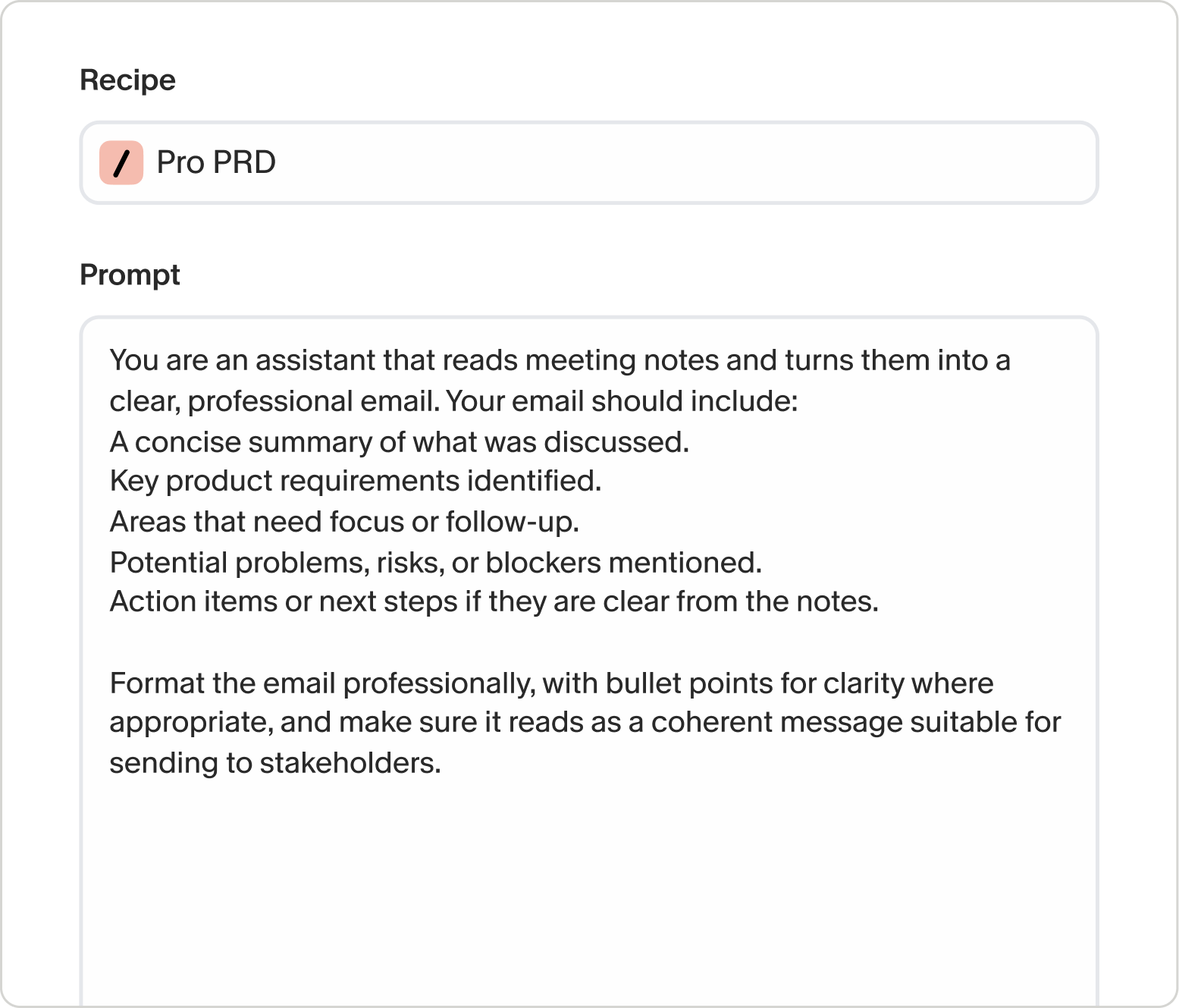
Granola's Recipes let you build reusable saved prompts for recurring workflows. Create a Recipe that extracts founder credibility signals, market sizing claims, and competitive differentiation from pitch transcripts. Run it after every pitch and your pattern recognition happens across deals rather than within a single conversation.
Uncovering red flags in founder pitches
Granola Chat can show you where a founder gave specific metrics versus stayed at a high level, where the conversation dynamic shifted, and which topics generated the most back-and-forth. Ask it to compare how the founder responded to questions about customer acquisition cost versus questions about product roadmap, and it will pull the relevant exchanges with inline citations back to the source. What those patterns mean for your diligence process is your call to make.
This kind of analysis requires a complete, accurate transcript and a tool that can query it intelligently. Generic summaries smooth over the inconsistencies that matter most for investment decisions.
Comparing note capture approaches for high-stakes conversations
| Feature | Bot-based notetaker | Device-level capture (Granola) |
|---|---|---|
| Meeting presence | Joins as a visible participant | Captures system audio from your device |
| Friction | Requires admitting the bot to the call | Nothing to add to the call to get started |
| Note quality | Automated summary | Human-guided enhancement |
| Audio storage | Audio storage varies by vendor | Audio deleted immediately after transcription |
| Setup time | Setup time varies by platform | Under 5 minutes: Download, connect calendar, start first meeting |
How Granola captures your calls
Granola accesses your device's microphone and system audio directly. The data flow runs in four stages: Capture device audio from your system audio layer, transcribe in real time, delete the audio file automatically, and process the text transcript through AI enhancement to produce your notes.
Granola runs on your device, so it works with any meeting platform, including Zoom, Google Meet, Microsoft Teams, Slack huddles, and WebEx.
Security and compliance: Granola is SOC 2 Type 2 certified (as of July 2025) and GDPR compliant. Third-party AI providers are contractually prohibited from training on your data, and all audio is deleted immediately after transcription. Audio is deleted after transcription in line with Granola's retention policy, and notes are encrypted in transit and at rest.
Assessing AI note quality for investment decisions
Not all AI note enhancement produces the same signal depth. The quality of your enhanced notes depends on the accuracy of the transcription, the specificity of your rough notes during the call, and whether the AI is working from your judgment or summarizing everything equally.
Measuring signal depth in meeting notes
The test for a good pitch note is not whether it is comprehensive. It is whether a partner who was not on the call can read your IC memo and understand why the deal should or should not move forward. Specific founder quotes beat summaries. Named team members and investors beat "the team." Exact metrics on CAC, churn, and burn beat "they mentioned some numbers."
Human-guided enhancement produces this level of specificity because your rough notes tell the AI what mattered. A note that says "Enterprise sales concerns" will produce different, more useful output than a fully automated summary that treats all topics equally.
70% of Granola users return the following week after their first meeting, and half remain active at 10 weeks averaging 6 meetings weekly. The retention reflects a simple mechanism: no new interface to learn, just a notepad that captures what you hear and enhances what you write.
Try Granola for free: Download the Mac, Windows, iOS, or Android app, connect your calendar, and run your next founder pitch to see human-guided note enhancement in action.
FAQs
How does Granola capture my meetings?
Granola runs on your laptop or phone and captures device audio to help generate notes during and after your meetings. You jot what matters during the call, and enhancement fills in the specifics from the transcript afterward, so the written record is detailed without you typing through the conversation.
Does Granola work with any meeting platform?
Yes. Because Granola captures system audio locally, it works with any platform that runs audio through your device, including Zoom, Google Meet, Microsoft Teams, Slack huddles, WebEx, and even FaceTime or WhatsApp calls.
Does Granola store audio recordings from my calls?
No. Granola captures device audio and transcribes in real time, then deletes the audio file automatically after transcription completes. Audio files are deleted after transcription completes; the resulting notes and transcript are stored in your Granola account, encrypted in transit and at rest. Granola is SOC 2 Type 2 certified as of July 2025 and GDPR compliant.
Glossary
Device-level capture: A method of transcribing audio directly from your device's system audio layer, so notes can be generated during and after a meeting on any platform that runs audio through your device.
Recipes: Reusable saved prompts in Granola. You build a Recipe once for a recurring workflow, such as extracting founder credibility signals or mapping a call to qualification criteria, and run it after every relevant meeting.
Granola Chat: Granola's cross-meeting query tool. Ask questions across your entire archive of meeting notes and get answers with inline citations that link back to the source conversation.
SOC 2 Type 2: A security and compliance certification that verifies an organisation's controls for data security, availability, and confidentiality have been independently audited over a sustained period. Granola achieved SOC 2 Type 2 certification in July 2025.