



How to document customer interview notes with AI
February 11
TL;DR: Customer interviews create a painful trade-off: take detailed notes and miss body language cues, or stay present and lose the quotes stakeholders demand for roadmap decisions. The AI notepad method solves both: you jot key moments, Granola generates notes from your device's audio, then enhances your notes afterward with verbatim quotes from the transcript. Tell participants you're using Granola to transcribe the conversation, then keep your attention on them: you maintain eye contact and ask better follow-up questions while capturing rigorous qualitative data. The result is stakeholder-ready research without sacrificing the human connection required for deep discovery.
Customer interviews create a consistent trade-off: capture the words and lose the meaning, or stay present and lose the evidence stakeholders demand. Most researchers toggle between these failure modes weekly. The AI notepad method solves this by letting Granola transcribe in the background while you jot only key moments, then fills in context with exact quotes after the call ends. This guide covers how to take customer interview notes with AI: what to write down during the call, and how transcription fills in the rest afterward.
The trade-off: Active listening vs. accurate documentation
Note-taking during interviews creates cognitive load that prevents deep listening. Research on investigative interviewing found that participants taking notes while conducting interviews experienced higher perceived cognitive load and demonstrated poorer recall performance. The act of writing divides attention between listening to the participant, formulating follow-up questions, and recording information.
What you lose when typing during interviews:
- Non-verbal cues: A customer pauses before answering your pricing question. Their tone shifts when discussing a competitor. They lean forward describing a workflow pain point. These signals guide your next question, but only if you're watching instead of typing.
- Follow-up opportunities: Unexpected insights require immediate probing. If you're documenting the last answer, you miss the chance to ask "Tell me more about that."
- Accurate capture: Studies show notes made during interviews account for only 68% of the information provided, even when 98% accurate. You think you captured the insight, but you wrote your interpretation instead of their exact words.
I find that Granola provides detailed, thorough notes with actionable next steps in a clean format. I also enjoy the mobile app for taking notes during phone calls and in-person meetings. Granola is simpler to use and more efficient, producing more productive notes than Zoom and Gong notetakers." - Verified user on G2
How to keep your attention on the participant
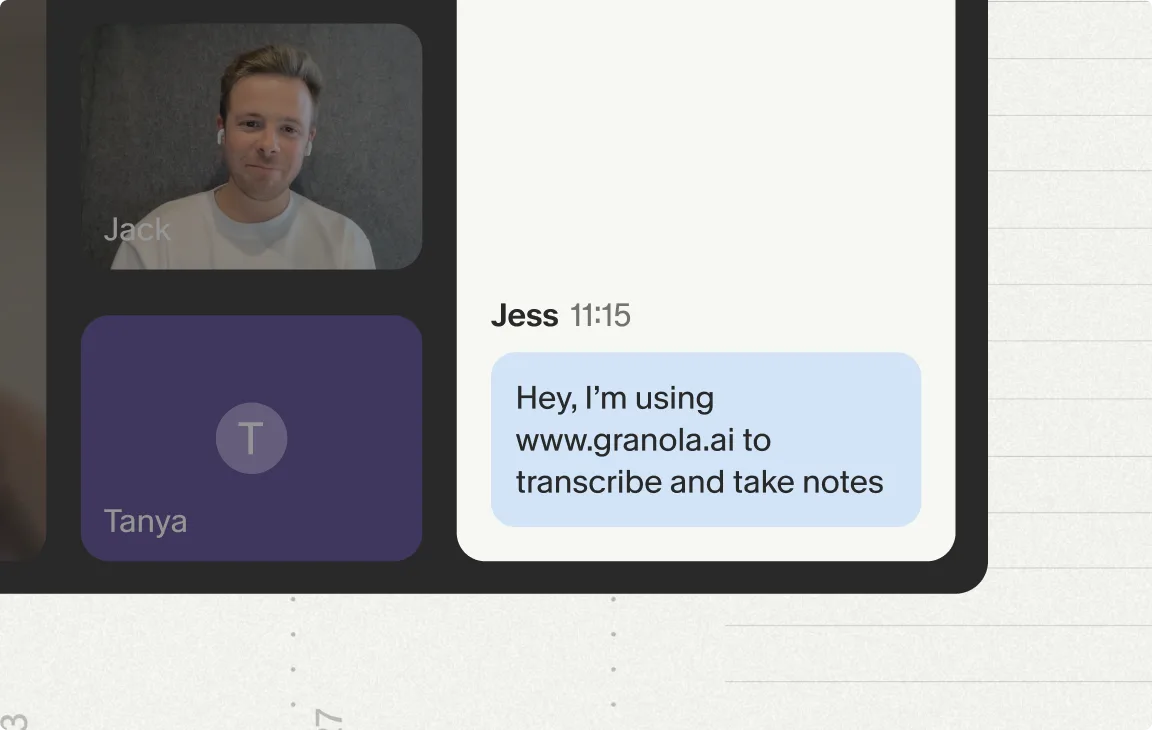
Interviews go better when your attention is on the participant rather than on your keyboard. Tell your customer at the start that you're using Granola to transcribe the conversation, then spend the rest of the call listening: watching for the pause before an answer, the shift in tone, the lean forward. Those are the signals that tell you which question to ask next, and they are the ones a written record cannot recover afterward.
Interviews are demanding for the interviewer too: listening, tracking the thread, and deciding what to ask next all compete for attention at the same time. The less of that capacity you spend on transcription, the more you have for the conversation itself.
Sensitive conversations, including early-stage discovery, competitive feedback, discussions about switching costs, and interviews in regulated industries, are exactly the ones where recall matters most. Tell participants you're using Granola to transcribe, then give the conversation your full attention. The verbatim record afterward means you don't have to reconstruct what was said from memory.
"It's literally the best. It doesn't join your calls like other AI note takers (that was big for me) and the AI is ACCURATE." - Verified user on G2
A better framework: The AI notepad method for interview transcription
The AI notepad method solves the trade-off by separating human judgment from mechanical capture. You write what matters during the meeting. AI fills in the details afterward. The result is a record accurate enough for stakeholders and an interview where your attention stayed on the participant.
The two halves work together. Your notes capture what you decided mattered in the moment: a pricing objection, a workflow pain point, a competitor mention. The transcription captures everything you said, word for word, so you can go back for the exact quote a stakeholder wants to see. Neither one replaces the other.
Step 1: Prepare your discussion guide
Before the interview, load your research questions into Granola's notepad using custom templates. The discussion guide provides structure without forcing rigid frameworks. Modify templates to match your interview type:
- Discovery calls: Focus on pain points and workflows
- Validation interviews: Emphasize feature reactions
- Competitive research: Probe switching considerations
Granola connects to your calendar and prompts you when meetings start, but you control when transcription begins. The setup takes under five minutes: download the Mac or Windows app, grant microphone permissions, connect your calendar, and you're ready for your next interview. When you prepare questions in advance, you free cognitive capacity for active listening instead of scrambling to remember what to ask next.
Step 2: Jot rough notes to stay focused
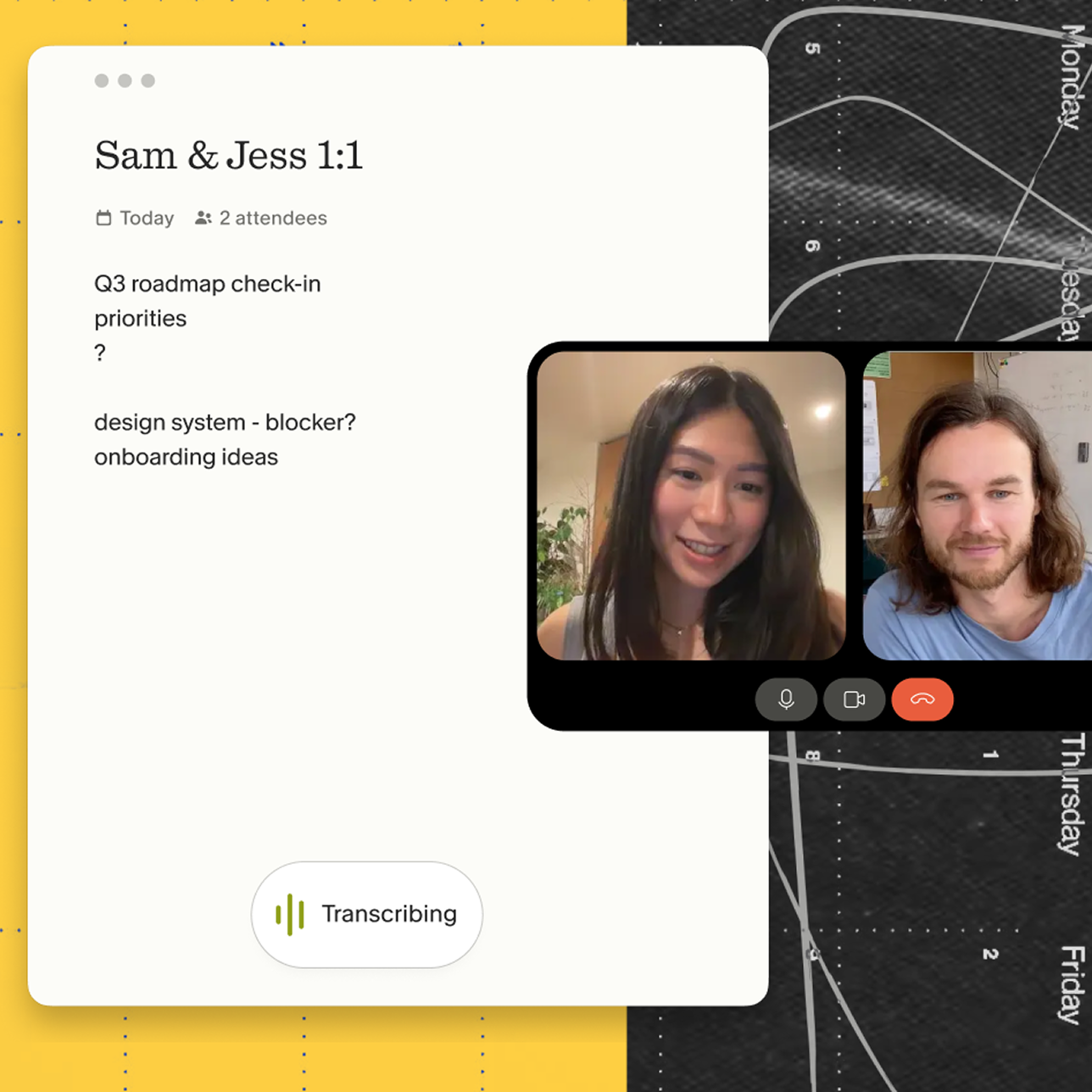
During the interview, write brief anchors to mark key moments. A customer describes a painful workflow: you type "manual export process." They mention a competitor: you note "switched from Asana." They reveal a budget constraint: you write "approval requires CFO." These anchors guide AI enhancement later while keeping you present now.
The anchor technique maintains eye contact and preserves your ability to read the room. Granola runs on your laptop or phone and uses your device's audio to generate notes. Let your participant know you're using Granola to transcribe the call, then work in your notepad while they talk.
"Granola was a very simple tool to set up and start using. It has been extremely useful in making notes on calls with prospective customers as well as team meetings, and allows me to focus on the conversation with confidence, that the important points are being noted." Tom S. on G2
Capturing information competes directly with processing it. By writing only anchors instead of full sentences, you preserve mental capacity for asking follow-up questions when a customer reveals something unexpected.
Step 3: Let AI fill in the context
When the meeting ends, Granola combines your anchor notes with the transcript to generate enhanced notes. Granola uses your jottings as signals for what matters. If you wrote "pricing objection," the enhanced notes include the customer's exact words about budget constraints, not a generic summary.
Granola analyzes who is in the meeting, what their roles are, and what you're trying to achieve. It understands that you care about different things in a customer interview versus a sales call or internal sync, and structures notes accordingly. The enhanced output includes verbatim quotes where they matter, synthesized themes across topics, and action items with clear owners.
You can chat with your notes to pull specific details: "What did the customer say about onboarding?" returns the relevant section with citations to the transcript. Granola's "Recipes" feature provides pre-built AI prompts to turn notes into PRDs or briefings, bridging the gap between research conversation and product execution.
"What I like best about Granola is how effortlessly it handles meeting notes without disrupting the flow of the conversation. It listens directly from my device audio no bots joining calls and produces clean, structured summaries with decisions, action items, and key points." - Brahmatheja Reddy M. on G2
Data privacy and participant trust in the age of AI
Privacy concerns about AI tools training on sensitive customer data are justified. Teams conducting competitive research, pricing discussions, or early-stage discovery often capture information customers wouldn't want shared with third parties.
Granola's privacy architecture uses transcription-then-deletion. Granola transcribes audio in real-time, then deletes it. No recordings are stored anywhere. Only text transcripts and summarized notes persist on secured AWS servers in US-East, encrypted at rest and in transit via AES-256. Granola achieved SOC 2 Type 2 compliance in July 2025.
For AI model training, third-party providers are contractually prohibited from using your data to train their models. The company may use de-identified data for lawful business purposes including training AI models that support the service, but you can opt out within account settings.
Checklist: Running a customer interview with Granola
Pre-interview (10 minutes before):
- Open Granola and start a new meeting note manually
- Load your discussion guide template
- Test device audio to ensure transcription will capture clearly
- Review participant background so you can ask informed follow-ups
Opening the conversation (first 2 minutes):
- Ask for consent: "Mind if I use my notepad to capture this? It helps me focus on you instead of typing."
- Explain briefly: "The tool transcribes in the background and deletes audio afterward. Only text notes are kept."
- Give them an out: "If you'd prefer I don't use it, that's completely fine."
- Wait for verbal agreement before proceeding
During the interview:
- Write brief anchors for key moments
- Maintain eye contact when participants describe pain points
- Mark unexpected insights with a quick asterisk or tag so AI enhancement prioritizes them
- Let silence happen. Don't fill every pause with typing
- When you hear something surprising, probe deeper instead of documenting immediately
Post-interview (within 30 minutes):
- Let Granola enhance your notes using your anchors and the transcript
- Chat with the notes to pull specific quotes
- Tag insights by theme: pain points, feature requests, competitive mentions
- Export to your research repository (Notion, Dovetail, or wherever your team centralizes findings)
"Granola nails exactly what I need: clean, reliable meeting transcripts and smart follow-up summaries without any fluff. I use it for nearly every call to stay focused on the conversation instead of scribbling notes. The follow-up action items are especially useful. Huge time saver." - Verified user on G2
How to synthesize insights across multiple interviews
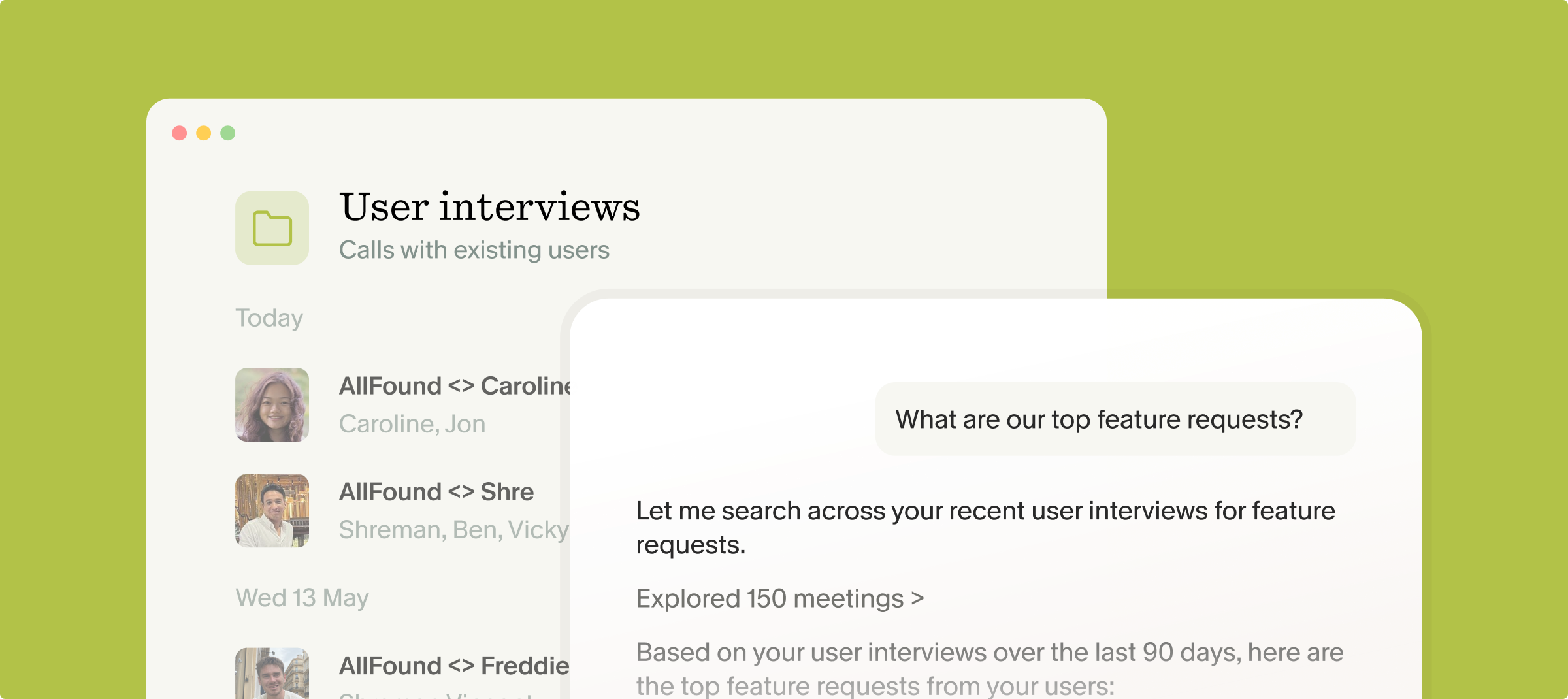
Granola's search and query features let you ask questions across all customer conversations to identify patterns, validate ideas, and prioritize what to build next. When you conduct 4-8 interviews weekly, the repository becomes a searchable record of every pain point, feature request, and competitive mention your customers shared.
Here's how this works in a prioritization meeting: Engineering wants to rebuild the export system. Marketing wants new integrations. Leadership asks which problem customers actually complain about. Instead of relying on memory or scrolling through Notion pages, you query your Granola folder: "What have customers said about export functionality in the last two months?" The system returns citations from specific interviews, with direct quotes and context. When stakeholders challenge your recommendations, a query that returns exact customer quotes from six conversations is harder to dismiss than a summary deck.
Team collaboration through shared folders extends this capability beyond individual note-taking. When multiple team members conduct research in parallel, shared folders create collective intelligence. One researcher interviewing enterprise customers discovers pricing objections. Another team member interviewing SMBs hears similar concerns. The shared folder query reveals the pattern neither would have spotted working in isolation. That shared history also outlasts any one researcher's tenure, so institutional knowledge about customers doesn't disappear when someone leaves the team.
The query capability addresses a common frustration: research insights that die in documents. Stakeholders want evidence for prioritization decisions, but finding that evidence buried in months of interview notes takes hours. A queryable repository surfaces the right quote at the right moment, making research findings actionable rather than aspirational.
"Granola captures notes so I can engage in discussions. Their implementation elegantly enables AI prompting without forcing the user into that mindset. Granola is the one tool I continuously have up during my day whether in a meeting or going back to 'ask questions' about what happened during the meeting." Andy C. on G2
Frequently asked questions about research documentation
Can I export these notes to Notion or Dovetail?
Yes, on Business and Enterprise plans. Granola offers native integrations with Notion, Slack, and HubSpot, plus Zapier connectivity for thousands of other apps. On the Basic plan, you can still copy-paste notes manually into Dovetail or anywhere else.
Does this work for in-person interviews?
Yes. Granola captures audio via your laptop microphone or mobile device, whether you're on a video call, sitting across a table, or even conducting a phone interview while commuting.
What if I forget to start Granola before the meeting?
Granola prompts you when meetings start based on calendar integration, but you control manual triggers. If you miss the beginning, start mid-meeting and capture the remainder.
What's the best app for transcription of interview transcripts?
There isn't a single best app across every use case, but for customer interviews specifically, an AI notepad that transcribes in the background while you take notes beats a separate transcription service you run afterward. Granola captures your device's audio during the call, so the transcript and your notes are both ready the moment the interview ends.
Key terminology
Observer effect: The phenomenon where people modify their behavior when they know they are being observed, documented in the Hawthorne studies and confirmed in qualitative research contexts.
Cognitive load: The mental effort required to perform simultaneous tasks, which in interviews includes listening, remembering, formulating questions, and recording information simultaneously.
Device audio capture: Transcribing audio via system microphone rather than a visible bot participant. Granola makes it easy to let other meeting participants know when this is in use.
AI notepad: A note-taking approach where you write key points and AI fills in context afterward, rather than fully automated summaries. Granola uses this method for customer research.
Customer interview notes: The anchors and observations a researcher writes during a customer interview, later enhanced with exact quotes pulled from the transcription. Granola's AI notepad method produces both from the same call.
Modular consent: A research ethics practice that allows participants to consent to specific aspects of a study separately rather than requiring blanket agreement to all conditions.