





Why deals stall: How missing call context breaks deal continuity
February 18
TL;DR: Your deals stall because you lose critical context during handoffs. When sales reps leave or deals transfer from SDR to AE to Customer Success, the nuanced details that made the opportunity real disappear. Granola runs on your laptop or phone and uses your device's audio to generate notes, creating a searchable repository where teams can query past calls to find exactly what a prospect said three months ago.
You know the pattern. An SDR qualifies a lead, an AE builds rapport and advances the deal, then turnover or reassignment wipes the slate clean. The new owner inherits sparse CRM notes and no memory of what made the opportunity real, no sense of what made the prospect feel urgent, no understanding of the relationship that was carefully built.
The deal stalls. Not because your solution changed or their budget disappeared. It stalled because you lost the context when your original rep left. According to research, replacing a sales rep costs around $115,000 and takes 189 days. But your hidden cost is worse. Every deal that rep touched now lacks continuity. Your new owner has to restart discovery, re-ask questions your prospect already answered, and rebuild trust you lost when the handoff fumbled.
The anatomy of a failed sales handoff
Sales handoffs fail at two critical junctions: internal transitions between SDR and AE, and external transitions from Sales to Customer Success.
The internal SDR-to-AE handoff collapses when critical details like pain points, use case, urgency, stakeholder map, and prior objections don't transfer cleanly. AEs restart discovery from zero, which reduces conversion and credibility. One of the biggest frustrations prospects report during the sales cycle is feeling like they're not being listened to.
If the SDR goes too far in their conversation, the AE unknowingly begins discovery in a way that forces the prospect to repeat themselves, creating a poor customer experience. Beyond these knowledge transfer failures, routing confusion adds friction when leads get reassigned or sit unaccepted due to territory edge cases.
The external AE-to-CS handoff fails for different reasons. Sales reps carry critical context in their heads: why the customer bought, what pain points drove the decision, which stakeholders care about what outcomes, what you promised during the sales cycle, and what objections you overcame. Very little makes it into the CRM. According to Rework benchmarks, handoff failure affects 40% of new customers and creates 15-25% higher first-year churn rates because CS teams lack the context needed to deliver on sales promises and address the specific pain points that drove the purchase decision.
Here's what separates effective handoffs from failures:
| Aspect | Effective handoff | Ineffective handoff |
|---|---|---|
| What gets shared | Structured notes with pain points, stakeholder map, objections overcome, and specific promises | Sparse CRM fields with deal size and close date |
| Who owns next steps | Single point of accountability with explicit timeline | Ambiguous assignment with no follow-up plan |
| Response speed | Next owner contacts prospect within 24 hours | Multi-day gaps that kill momentum |
| Continuity signal | New owner references prior conversation specifics | New owner starts fresh discovery, forcing repetition |
"I find that Granola provides detailed, thorough notes with actionable next steps in a clean format. Granola is simpler to use and more efficient, producing more productive notes than Zoom and Gong notetakers." - Verified user on G2
What walks out the door with every departing rep
According to research, the average sales rep turnover is 35 percent, higher than the average for all other industries at 13 percent. This disparity stems from the unique pressures of quota-carrying roles and the administrative load that comes with them.
But the deeper problem is what walks out the door with each departure: institutional knowledge about active deals, discovered objection patterns, stakeholder dynamics, and nuanced understanding of why prospects bought or didn't buy.
What drives reps to leave? The research points directly at process friction and tool inadequacy. Reps spend more time on duties such as data entry and paperwork, which means the average rep only spends about one-third of their time actually selling. Sales professionals who spend at least four hours on selling activities are happier in their role.
When reps spend their days fighting tools instead of selling, they leave. When they leave, deal context leaves with them.
The critical role of call notes in discovery
A good handoff template should capture key deal stages, decision-makers, past objections, next steps, and customer pain points. Critical information includes why the customer bought, what you promised during sales, who the key stakeholders are, success metrics they will use to measure ROI, and any red flags or concerns raised during sales.
But your discovery call notes fail to capture this context because your reps face an impossible tradeoff: take comprehensive notes or stay present in the conversation. You can't do both well simultaneously.
The best discovery calls follow a consistent pattern: reps who listen more than they talk close at higher rates. When reps dominate the conversation, they miss the budget hints, stakeholder mentions, and timeline signals that move deals forward.
Here's your problem: capturing those questions, the answers, the follow-up probes, the stakeholder mentions, the budget hints, and the timeline signals requires constant typing. That typing breaks eye contact, interrupts flow, and signals to the prospect that you're more interested in your notes than their pain. So your reps jot abbreviated bullets and promise themselves they'll fill in details after the call. Then three more meetings stack up back-to-back. By the time they return to those notes, they've lost the memory and forgotten the nuance. They enter a sparse summary into your CRM that captures what was said but misses why it mattered.
"With Granola I don't have to worry anymore about taking meeting notes, I can just write down things I really care about and let Granola take care of the rest. I don't worry about forgetting important things because it's all in there." - Jess M. on G2
Why deals stall and fall through
Differing priorities or miscommunication between your stakeholders can stall the decision-making process. If your prospects don't perceive their problem as critical, they'll deprioritize solving it. Research shows that 37% of deals stall because the salesperson lacks a clear grasp of the buyer's core issues.
Four root causes drive most stalls:
- Lack of urgency: Weak discovery means you fail to uncover the business impact, leaving buyers without a compelling "why buy now" case. Prospects might see how your solution could help but don't feel it's pressing enough to prioritize.
- Internal misalignment: Your deals require multiple stakeholders to agree. When the economic buyer, technical evaluator, and end user champion have different priorities, internal friction kills momentum. If buyers cannot see measurable business impact, urgency disappears.
- Unclear process: Your prospects often don't have a defined buying process for your category. When they hit procurement, legal review, or technical evaluation gates they didn't anticipate, deals stall while they figure out internal workflows.
- Weak qualification: Your reps advance deals that should have been disqualified. Budget constraints surface late. Authority assumptions prove wrong. Timing that seemed urgent turns out to be exploratory.
Now map these causes to your missing context during handoffs. Without proper context transfer, your AEs don't understand the "why now" your SDRs uncovered, leading to lack of urgency. When stakeholder maps aren't transferred, internal misalignment occurs. Missing context about the prospect's evaluation process creates unclear process issues. Weak qualification happens when original discovery notes don't reach your AE.
Context loss doesn't just make your handoffs messy. It directly causes the conditions that stall your deals. This problem extends beyond sales. When your Product team can't access sales conversations, they build features based on guesses instead of real customer pain. When your Customer Success inherits accounts with no record of what you promised during sales, they can't deliver on your commitments. One of the top reasons for high customer churn is the disjointed onboarding process between sales and customer success.
"I love that you can blend shorthand with AI notes. It's also super intuitive and super easy to use. I use this nearly every day for work." - Mason K. on G2
How Granola bridges the context gap
Granola solves context decay by running on your laptop or phone, using your device's audio to generate notes, and turning your rough bullets into comprehensive, searchable records.
Capture that keeps you present in the conversation
Granola runs on your laptop or phone and uses your device's audio to generate notes, so you can keep your attention on the conversation. It works across Zoom, Google Meet and Teams, and the notes are ready when the call ends.
Think of it as a research assistant who listened alongside you. You wrote the structure during the call, they fill in supporting details, exact quotes, and context afterward.
This matters most on high-stakes discovery calls. Executive buyers, procurement teams evaluating competitive bids and enterprise customers discussing detailed pain points all say things you will need again months later, and Granola gives you an accurate record of them so you can listen and respond instead of typing.
Tell the other participants that you're using Granola to transcribe the call. It takes a moment, and it's the right way to begin any recorded conversation.
AI-enhanced notes turn bullets into context
Granola combines your own typed bullet points with a full AI transcription to generate polished, accurate summaries tailored to specific meeting types. You jot key points during the call. Granola generates notes from your device's audio, so you can give the conversation your full attention and review the write-up afterwards. After the meeting, click to enhance your notes, and the AI merges your typed points with the transcript to create a comprehensive, structured summary.
You control what stays and what gets deleted. You control the structure. Granola's AI adds supporting details, exact quotes, and context you didn't have time to capture while listening. Customizable templates for different types of meetings ensure that discovery calls surface pain points and stakeholder mentions, sales handoffs include objection history and next steps, and customer success calls flag implementation concerns and success metrics.
Searchable repository makes context queryable
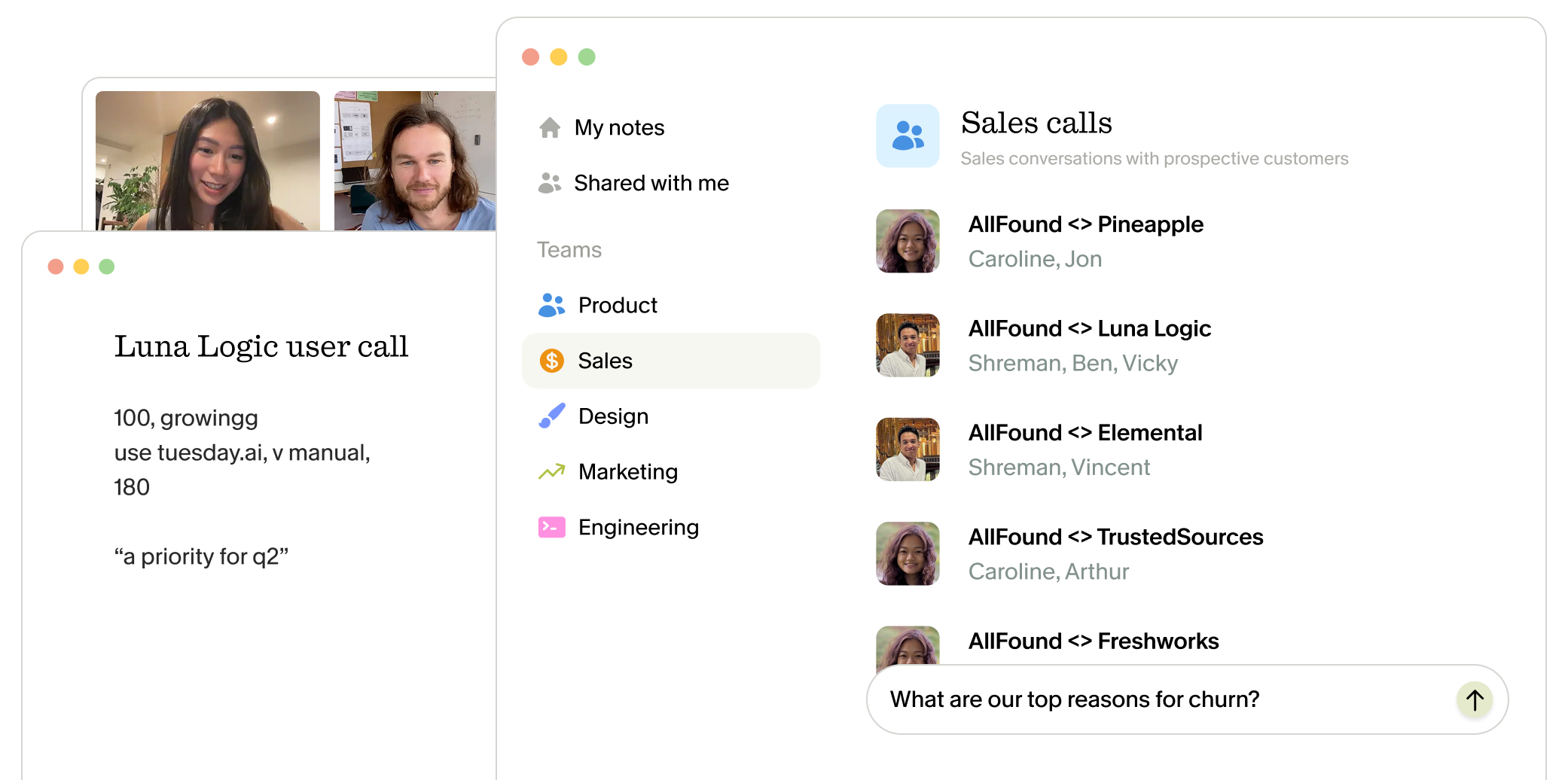
Granola introduced team collaboration features that turn individual notes into shared, searchable knowledge. Create shared folders for departments or projects, set permissions for private or team access, and query across entire folders with questions like "What were the top customer pain points mentioned this quarter?"
You can ask questions about meeting content during or after the call, such as "What did the CFO say about budget?" The AI assistant provides targeted answers based on the transcript. This feature enhances your recall and follow-up efficiency.
For you as a sales leader, this means you can query "Why are enterprise customers hesitating about our implementation timeline?" and get citations from 10+ discovery calls. When your rep leaves, their replacement can ask "What objections did this prospect raise in previous conversations?" and find exact quotes with context. When Product asks "What are prospects saying about competitor integrations?", you can answer with evidence, not anecdotes.
The platform focuses on privacy and workflow integration, allowing you to query your meeting history via an AI chat interface. Granola is SOC 2 Type 2 certified as of July 2025, with audio transcribed in real-time then deleted. No recordings stored anywhere. Third-party AI providers like OpenAI and Anthropic are contractually prohibited from training on your data.
"Easy to set up and runs quietly in the background. Accurate discussion summaries with the backup transcript available." - Joe M. on G2
Stop losing deals to context decay
Your deals aren't stalling because of your product or pricing. They're stalling because the context that made them real disappears during handoffs.
Download Granola for Mac, Windows, iOS or Android, connect your calendar, and capture your next discovery call. See how AI-enhanced notes preserve the context that keeps deals moving. Setup takes under 5 minutes.
Need team-wide context sharing? Start a Business trial at $14 per user per month to create searchable folders where deal context survives turnover and handoffs.
"I find that Granola Web and Mobile is far superior for taking notes and creating transcripts for several reasons: It works seamlessly across all conference software. It takes accurate notes. Overall, the value of Granola far exceeds its price." - Cory M. on G2
Frequently asked questions
How much revenue do your companies lose from poor sales handoffs?
Your sales organizations lose 13-17% of annual revenue when information doesn't transfer between your reps, and 40% of your new customers experience handoff failures that create 15-25% higher first-year churn.
How does missing context stall your deals?
37% of deals stall because your salesperson lacks a clear grasp of the buyer's core issues. When your handoffs lose urgency context, stakeholder maps, or process understanding, your new owners can't maintain momentum.
Why do your CRM notes fail to preserve context?
Your reps can't simultaneously take comprehensive notes and stay present in conversations. Generic CRM software makes it difficult to capture conversation context, and typing ideas into your CRM during calls drains energy that isn't sustainable.
How does Granola capture my calls?
Granola runs on your laptop or phone and uses your device's audio to generate notes, so it works the same way across Zoom, Google Meet and Teams. Tell the other participants you're using Granola to transcribe the call.
Key terms
Context decay: The progressive loss of critical deal information when you transfer it between people, systems, or over time. Most of your handoff failures come from missing context, not bad intent.
Deal continuity: Continuous preservation of your deal context across all stages and stakeholders so your momentum continues and deals keep progressing.
Discovery context: Comprehensive information from your initial sales conversations including pain points, stakeholder dynamics, objections, urgency drivers, and promised outcomes that your basic CRM data points can't capture.
Sales handoff: Transfer of account ownership and deal context between your team members at critical junctions like SDR-to-AE, AE-to-CS, or during rep turnover, where information quality determines your success.