




How to capture competitor intelligence from sales calls with AI notes
February 19
TL;DR: Your sales team talks to competitors' customers every day and hears exactly why prospects choose alternatives, what features move deals, and where your product falls short. Granola runs on your laptop or phone and uses your device's audio to generate notes, so reps can stay present in the conversation instead of typing. Tell participants you're using Granola to transcribe the call, then query those notes across dozens of calls to answer "Why do we lose to Competitor X?" with source-linked evidence that defends roadmap decisions.
Your sales and customer success teams conduct dozens of conversations weekly with people who have evaluated your competitors, switched from rival products, or actively compared features during their buying process. As a PM, you need access to these unfiltered market signals: the exact phrasing prospects use to describe competitor strengths, the specific objections that kill deals, and the feature gaps that send buyers elsewhere. Yet most product teams build roadmaps from lagging indicators like quarterly analyst reports while this real-time intelligence evaporates.
The problem is not access to sales calls. The problem is that competitive intelligence dies in two places: in manual notes that capture opinions instead of verbatim quotes, and in recordings nobody has time to review. Voice of the customer means actual customer descriptions in words for the functions and features they desire, not a sales rep's interpretation filtered through their memory three days later.
You need systematic capture and synthesis infrastructure that preserves what prospects actually said about your competitors, then makes that intelligence queryable when roadmap decisions matter.
Why sales calls are your best competitive intelligence source
Traditional market research delivers insights months after market shifts occur. Sales conversations provide leading indicators in real time: when three prospects in one week mention the same competitor feature you lack, that signals genuine market demand before it shows up in quarterly reviews.
The difference matters for decision speed. You can query 40 discovery calls from the last month and find every mention of a specific competitor weakness, or wait for user research to schedule interviews, conduct sessions, synthesize findings, and present recommendations six weeks later. Real-time access to sales conversations gives you strategic options that lagging indicators cannot provide.
The gap between sales conversations and product strategy
When you review sales calls, you notice that reps focus on closing deals, not capturing product nuance. The notes that make it into your CRM typically document whether a competitor was mentioned, not the specific language the prospect used to compare solutions. You lose the verbatim phrasing that reveals customer mental models and the contextual details about workflow problems that prompted the comparison.
Manual note-taking during calls creates a forced choice between presence and documentation. A rep who is typing detailed notes about a competitor mention cannot simultaneously read the prospect's body language, ask follow-up questions, or build rapport. You cannot actively listen while typing comprehensive notes, which means critical insights get missed.
The synthesis gap compounds the problem. Even teams that record calls rarely review them because the time cost is prohibitive. Transcripts provide searchable text, but finding the two-minute segment where the prospect discussed competitor pricing still requires reading through 40 minutes of conversation.
How to capture competitive intelligence with AI notes
Choose a capture method that matches your use case
AI meeting assistants like Fireflies and Otter join calls as participants to record conversations. Conversation intelligence platforms provide deep analytics for sales coaching and performance management, and are enterprise solutions built primarily for sales leaders analyzing team performance across large teams.
AI notepads like Granola run on your laptop or phone and use your device's audio to generate notes. Reps jot rough notes during the call while Granola transcribes, and the notes are enhanced with relevant context from the transcript afterward, so the prospect's exact phrasing about competitors is preserved without anyone writing it down in the moment.
Set up your sales team for competitive intelligence capture
Install Granola on your sales team's devices and connect to their calendars so the app prompts them to start capturing when meetings begin. Create shared folders for "Competitor Intelligence Q1 2026" and "Feature Requests" so all notes flow into centralized repositories you can query later.
Train reps to type brief headers when topics shift during calls: "Competitor X pricing concerns" or "Feature gap: reporting dashboard." They are not transcribing, they are creating an outline of what matters. When a prospect mentions a competitor, reps jot the competitor name and general topic. When prospects describe features they wish you had, reps note the feature category. These rough notes serve as signposts that tell the AI which parts of the transcript matter most for synthesis.
"I love that you can blend shorthand with AI notes. It's also super intuitive and super easy to use." - Mason K. on G2
The goal is to keep reps present in conversations so they can maintain eye contact, ask follow-up questions, and read subtle signals about why a competitor came up. The AI handles documentation so reps focus on extracting insight through conversation, not typing.
Analyze enhanced notes for competitive patterns
After each sales call, AI enhancement expands the rough headers with relevant details from the transcript. A header like "Competitor X pricing concerns" becomes a structured section with the prospect's verbatim quote about why they found the competitor expensive, followed by context about which tier they evaluated and what features they needed.
The enhancement preserves the sales rep's structure while adding the specific language that would have been missed in manual notes. You control what sections exist based on what the rep typed during the call. The AI fills in supporting detail, not generic summaries that bury the insight.
Tag notes immediately with competitor names, deal stages, and topic categories. Create tags like #competitor-salesforce, #pricing-objection, or #feature-request-sso so you can retrieve related notes later through search. This tagging discipline turns individual meeting notes into queryable competitive intelligence infrastructure.
"Granola nails exactly what I need: clean, reliable meeting transcripts and smart follow-up summaries without any fluff. The follow-up action items are especially useful." - Verified user on G2
Three specific workflows for extracting competitive intelligence
1. Feature gap analysis through pattern recognition
When prospects mention features you lack, the specific language they use reveals whether the gap is critical or nice-to-have. A prospect who says "we cannot buy without SSO" signals different urgency than one who says "SSO would be convenient eventually."
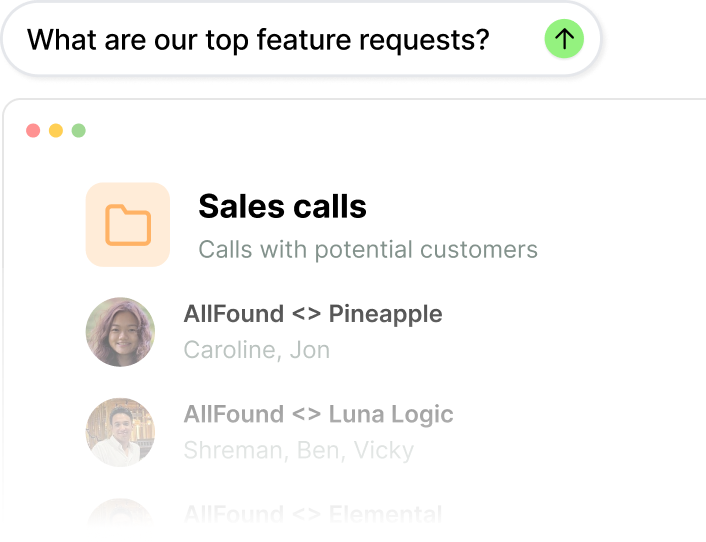
Query your shared folder with targeted questions like "What reporting capabilities did prospects request in the last 30 days?" and receive a summary with citations linking back to specific calls. The query returns verbatim quotes so you can validate that three different prospects used nearly identical language to describe the same dashboard need, which signals genuine market demand rather than one vocal customer's preference. You can present this evidence to stakeholders when defending roadmap prioritization decisions.
2. Pricing intelligence and positioning analysis
Prospects reveal competitor pricing through indirect comments in the course of a call: "Vendor Y offered 30 percent off their list price" or "Competitor Z charges per seat but includes unlimited contacts.": These details inform your pricing strategy if you capture them accurately.
When you capture pricing mentions in enhanced notes, you build a database of competitor discount patterns, packaging differences, and pricing objections that surface across multiple deals. Query this data by competitor name to identify which rivals discount aggressively at quarter-end or which competitors prospects consistently describe as expensive relative to value delivered. If prospects repeatedly mention that Competitor A is cheaper but harder to implement, that contrast becomes your positioning angle in discovery calls.
3. Win-loss analysis with conversational evidence
Traditional win-loss analysis asks sales reps why deals closed or died, but reps interpret conversations through their own biases. Enhanced notes provide the prospect's actual reasoning in their words. When you close a deal, your notes capture which specific capabilities or proof points moved the buyer from consideration to commitment. When you lose, the notes reveal whether the decision turned on price, features, timeline, or trust factors.
Create separate folders for won deals and lost deals, then query each folder to identify patterns. Ask "What competitive strengths did prospects mention in lost deals?" across 20 opportunities that went to Competitor X, and the AI synthesizes common themes with source citations. Compare that pattern against "Why did prospects choose us in won deals?" to find the specific differentiators that actually influence buying decisions.
"This tool allows me to be fully present in every candidate conversation without worrying about taking detailed notes in real time. Granola not only transcribes interviews accurately, it also organizes the information directly into my personalized template." - Syl C. on G2
Top AI tools for competitive intelligence from sales calls
Different tools serve different use cases in competitive intelligence capture and analysis.
| Tool | Primary use case | Capture method | Best for |
|---|---|---|---|
| Granola | Personal AI notepad for individual productivity and research | Bot-free device audio capture | Individual PMs and researchers who need accurate notes they can query later |
| Gong | Conversation intelligence platform that captures, transcribes, and analyzes business conversations to turn unstructured communication into structured data | Bot joins as participant | Enterprise sales teams needing CRM integration and conversation analytics for coaching |
| Crayon | Competitive intelligence platform that monitors competitors and enables sales teams with real-time intelligence | Manual input plus automated web monitoring | Marketing and PMM teams needing automated competitive tracking and battlecards |
| Klue | Competitive enablement platform for collecting and delivering competitive intelligence across departments | Manual input plus automated competitive monitoring | Sales enablement teams needing comprehensive CI platform with win-loss integration |
| Otter | AI meeting agent that automatically records and transcribes calls | Bot joins as participant, also offers bot-free option | Teams needing transcription plus basic meeting intelligence at lower cost |
Individual PMs doing discovery research need different capabilities than sales leaders analyzing team performance across 100 calls weekly. Granola optimizes for personal productivity and deep queryability of conversation content rather than surface-level analytics about talk ratios or sentiment scoring.
Implementation checklist for your competitive intelligence system
1. Audit your current capture and synthesis process: How do sales and customer success teams currently document competitor mentions? Where does that information live and who can access it? How much time passes between a competitor mention in a call and that insight reaching product strategy?
2. Define your intelligence wishlist: What specific competitor behaviors do you need to track such as pricing, product launches, or messaging shifts? Which feature gaps are costing you deals and need validation? What win-loss patterns remain unclear from CRM data alone?
3. Set up your repository structure: Create shared folders for competitive intelligence, feature requests, and win-loss insights. Establish tagging conventions that your whole team will use consistently. Document where different types of intelligence should be stored so teammates can find insights independently.
4. Establish query routines: Schedule weekly reviews where you query folders for patterns like "What objections came up most this week?" Set up monthly competitive deep-dives where you analyze all mentions of your top three rivals. Create saved queries you can re-run each period to track how specific themes evolve over time.
5. Connect insights to decisions: Share competitive intelligence in roadmap planning meetings with source citations from actual calls. Build lightweight battlecards from patterns in your notes rather than from outdated market research. Track which product decisions were informed by sales call intelligence versus other sources to prove ROI.
Start capturing competitive intelligence today
Sales conversations contain the market reality you need to build products people actually buy. The competitive intelligence sitting in your team's calls right now will inform your roadmap or your competitor's roadmap depending on who builds better capture infrastructure first.
Download Granola and set up your sales team to capture their next discovery calls, letting participants know at the start that Granola is transcribing. Create a "Competitor Intel Q1 2026" shared folder and establish tagging conventions for competitor mentions.
The best product strategies are built on evidence, not intuition. Start collecting that evidence today.
Frequently asked questions
Can AI notes replace a dedicated competitive intelligence team?
No, AI notes augment CI teams by automating data collection and synthesis. Human analysts still interpret patterns, prioritize threats, and develop strategic responses, but AI eliminates the manual transcription and initial categorization work that consumes most of their time.
What is the difference between conversation intelligence and AI notes?
Conversation intelligence platforms analyze patterns across hundreds of calls to provide team performance metrics, coaching insights, and revenue forecasting. AI notepads focus on capturing and querying individual conversation content for personal productivity and research synthesis.
How do I ensure compliance when recording sales calls?
Verify your state and prospect location against two-party consent requirements. Always disclose note-taking at the start of calls, even when legally allowed to record without explicit consent.
Can I integrate AI notes with my CRM?
Granola integrates with HubSpot, Attio, and Affinity. Enhanced notes automatically sync to relevant contact, company, or deal records.
Key terms glossary
Competitive Intelligence (CI): The systematic process of gathering and analyzing information about competitors' products, strategies, and market positioning to inform your own strategic decisions and improve organizational performance.
Voice of the Customer (VoC): Actual customer descriptions in their own words for the functions, features, and experiences they desire. VoC differs from interpreted customer feedback by preserving specific language and phrasing customers use.
Battlecards: Concise competitive summaries that document a rival's strengths, weaknesses, pricing, and positioning. Sales teams use battlecards to handle objections and position your product against specific alternatives during discovery calls.
Bot-free capture: Capturing device audio directly from your computer without software joining the video call as a participant.
Win-loss analysis: The systematic review of closed deals to identify why prospects chose your solution or selected a competitor. Effective win-loss analysis relies on actual conversation data rather than sales rep interpretations filtered through memory and bias.
AI notepad: A meeting tool where you jot rough notes during the conversation and AI enhances them with transcript context afterward.
AI notes: Meeting notes that combine what you wrote with AI-generated context pulled from the transcript. In Granola, your notes stay in black and AI additions appear in gray.